


What Allergens Must Be Labelled? The 14 Allergens Explained
Fourteen allergens must be declared on food sold in Ireland: celery, cereals containing gluten, crustaceans, eggs, fish, lupin, milk, molluscs, mustard, peanuts, sesame, soybeans, sulphur dioxide and sulphites, and tree nuts. On prepacked food they must stand out in the ingredients list, for example in bold, so a customer can spot them quickly.
Please note: this is general information to help you get the basics right, not legal advice. Always confirm your own obligations with the FSAI (Food Safety Authority of Ireland) or a qualified adviser.
What are the 14 allergens?
The 14 allergens are celery, cereals containing gluten, crustaceans, eggs, fish, lupin, milk, molluscs, mustard, peanuts, sesame, soybeans, sulphur dioxide and sulphites, and tree nuts. Every food business selling to the public must be able to tell a customer which of these 14 a dish contains, whatever form the food is sold in.
The list is fixed. You do not add to it or drop items from it based on how common an allergy seems. Other ingredients can cause reactions, but these 14 are the ones the law names, so these are the ones your labels and your staff must cover.
| Allergen | What it covers | Often hides in |
|---|---|---|
| Celery | Stalks, leaves, seeds, celeriac | Stocks, soups, spice mixes |
| Cereals containing gluten | Wheat, rye, barley, oats, spelt, kamut | Sauces, batters, coatings, stuffing |
| Crustaceans | Prawns, crab, lobster, crayfish | Shellfish stock, pastes, prawn crackers |
| Eggs | Whole egg, white, yolk, dried egg | Mayonnaise, glazes, pasta, cakes |
| Fish | All fish and fish products | Worcestershire sauce, fish sauce, dressings |
| Lupin | Lupin seeds and lupin flour | Some breads, pastries and gluten-free flours |
| Milk | Cow, goat, sheep milk and dairy | Butter, ghee, whey powder, glazes |
| Molluscs | Mussels, oysters, squid, snails | Oyster sauce, seafood mixes |
| Mustard | Seeds, powder, mustard leaves | Dressings, marinades, curry pastes |
| Peanuts | Peanuts and peanut oil | Satay, some baked goods, snack mixes |
| Sesame | Seeds, sesame oil, tahini | Burger buns, hummus, dips |
| Soybeans | Soya, tofu, soya flour | Soy sauce, vegetarian products, oils |
| Sulphur dioxide and sulphites | Used as a preservative | Dried fruit, wine, some meats |
| Tree nuts | Almond, hazelnut, walnut, cashew, pecan, brazil, pistachio, macadamia | Pesto, praline, nut oils, desserts |
How must allergens be shown on a label?
On prepacked food, each of the 14 allergens must appear in the ingredients list and be emphasised so it stands out from the rest. Bold type is the usual method, though capitals, underlining or a contrasting colour also work. The allergen is named by its real name, so "milk" rather than a vague term like "dairy solids".
Two rules trip people up. First, the allergen has to sit inside the ingredients list, not only in a separate box underneath. Second, "may contain" warnings are voluntary and cannot replace a proper declaration. Use them only where there is a genuine cross-contact risk you cannot design out, and never as a blanket cover-all.
Keep the print readable. A label a customer has to squint at does not do its job, and an inspector will say so. If your ingredients list is long, a slightly larger label is worth the extra few cent.
Do the rules change for food made and sold in your own shop?
Yes, the format changes with how the food is sold. Fully prepacked food carries a full ingredients list with allergens emphasised. Food prepacked for direct sale, such as a sandwich made in-store, needs its own ingredient and allergen label. Food sold loose still needs allergen information, given in writing or clearly signposted.
Which category your food falls into, and what each one asks for on the pack, is a whole subject of its own. The walkthrough is in Natasha's Law and PPDS allergen labelling. What matters here is that the list of 14 never changes between them. Only the way you present it does.
So whichever category you are in, the groundwork is the same: know which of the 14 are in every dish you make, and be able to prove it from your recipe records rather than from memory.

Where do allergens hide that people miss?
Allergens hide in sauces, stocks, marinades, oils and coatings far more often than in the headline ingredient. Soy sauce carries wheat. Worcestershire sauce carries fish. Some gluten-free flour blends carry lupin. Check every bought-in product's own label, and check it again when a supplier changes a recipe.
The habits that catch these:
- Read the label on every bought-in ingredient, including oils, stocks and spice blends.
- Re-check when a supplier changes recipe or you swap to a different brand mid-week.
- Keep the original packaging or a photo of it until the product is used up.
- Write down any dish change straight away, so the allergen matrix never lags behind the kitchen.
- Treat cross-contact as separate from ingredients: shared fryers, shared boards and shared utensils all matter.
Allergen work sits inside your wider HACCP routine, next to prep dating and stock rotation. See HACCP and food rotation labels for how the two fit together, and the pillar guide to food labelling compliance in Ireland for the whole picture.
What labels do you need to declare allergens properly?
Most food businesses need three kinds of label. Pre-printed allergen labels for deli counters and buffets, ingredient labels for food you prepack for direct sale, and dating labels for prep and use-by. Together they answer the two questions every inspector and customer asks: what is in it, and how long has it been there.
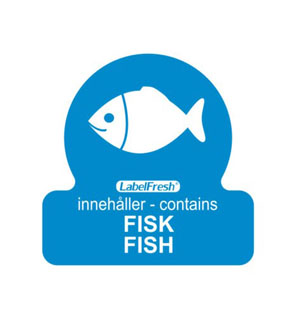
- Pre-printed allergen labels, one per allergen, for counters, trays and open display.
- Ingredient and PPDS labels, large enough for a full list with the allergens in bold.
- Prep, use-by and day dot labels for rotation. See use-by vs best-before.
- A written allergen matrix at the counter, one row per dish, for anything sold loose.
Get allergen labels that do the job
Pre-printed allergen labels, ingredient labels, day dots and use-by labels, at trade prices with fast Irish delivery.
Frequently asked questions
What are the 14 allergens that must be labelled?
The 14 allergens are celery, cereals containing gluten, crustaceans, eggs, fish, lupin, milk, molluscs, mustard, peanuts, sesame, soybeans, sulphur dioxide and sulphites, and tree nuts. On prepacked food each one must be emphasised in the ingredients list, for example in bold, so a customer can spot it quickly.
How should allergens be shown on a food label?
Each allergen must appear inside the ingredients list and stand out from the surrounding text. Bold type is the usual method, though capitals, underlining or a contrasting colour also work. Name the allergen plainly, so milk rather than a vague term. A separate allergy box alone does not meet the requirement.
Does food made and sold in my own shop need allergen labels?
Yes. Food you make and pack on the premises before a customer orders it needs its own ingredient list with allergens emphasised. Food sold loose still needs allergen information, given in writing or clearly signposted so staff can answer every time. Check current FSAI guidance for your exact setup.
Can I just write may contain nuts on everything?
No. May contain warnings are voluntary and cannot stand in for a proper allergen declaration. Use them only where a real cross-contact risk exists that you cannot design out of your process. Applying them to everything is unhelpful to customers with allergies and does not protect you.
Which foods hide allergens most often?
Sauces, stocks, marinades, oils and coatings are the usual culprits. Soy sauce commonly contains wheat, Worcestershire sauce contains fish, and some gluten-free flour blends contain lupin. Read the label on every bought-in ingredient and re-check whenever a supplier changes their recipe or you switch brand.
Who checks allergen labelling in Ireland?
The Food Safety Authority of Ireland oversees food safety and labelling, working with the HSE and local authorities who carry out inspections. The rules come mainly from EU food information law as applied in Ireland. The FSAI publishes plain-language guidance and is the place to check current detail for your business.