


Window Cleaning Tools: Squeegees, Scrims and Applicators Explained

Window cleaning tools come down to three items that do the real work. The applicator wets the glass and loosens dirt, the squeegee pulls that water and dirt off in clean strokes, and the scrim or microfibre dries the edges. Add a bucket and a glass cleaner and you can clean any window properly.
What tools does a window cleaner use?
A window cleaner uses an applicator to wet and scrub the glass, a squeegee to clear the water in overlapping strokes, and a scrim or microfibre cloth to dry the edges and corners. A bucket holds the water, and a glass cleaner or pure water does the washing. For high glass, a water-fed pole replaces the handheld set.
That short list covers almost every job. A shopkeeper cleaning the front glass needs nothing more. A professional carries the same three tools, just in more sizes, with spare blades and a pole for height. The pillar guide, window cleaning equipment, sets out the wider kit and where each part fits.
- Applicator (washer), a sleeve on a T-bar that holds water and loosens grime.
- Squeegee, a handle and channel holding a rubber blade that clears the glass.
- Scrim or microfibre, for edges, corners and any missed spots.
- Bucket, ideally with a sieve so you can wring the applicator.
- Glass cleaner or pure water for the wash itself.
What is a squeegee and how do you use one?
A squeegee is a handled blade with a rubber edge that wipes water and dirt off glass in one clean stroke. Wash the glass first with an applicator, then pull the squeegee down or across in overlapping strokes, wiping the blade dry between each one. Finish the edges with a scrim.
The squeegee has three parts. The handle you hold, the channel that holds the blade, and the rubber blade itself. The rubber is the part that matters. It has to sit flat and straight against the glass along its whole length. A blade with a nick, a bend or a rounded edge will leave a line of water behind on every stroke, and that line dries as a streak.
Two stroke patterns cover most work. On small panes, pull straight down from the top in overlapping vertical strokes. On wide shop glass, work across in a fanning motion so the water runs to one side and off. Either way, overlap each stroke into the last by a good margin so you never leave a dry gap.
What size squeegee should you buy?
Match the squeegee width to the glass you clean most. Wide blades clear large shop fronts and patio doors in fewer strokes. Narrow blades suit small panes, Georgian bars and awkward corners where a wide blade will not fit. Many cleaners carry one of each and swap as the job needs.
| Blade width | Best for | Why |
|---|---|---|
| Narrow | Small panes, sash windows, glazing bars | Fits between frames without catching |
| Medium | Standard house and office windows | The all-round choice if you buy only one |
| Wide | Shop fronts, patio doors, glass partitions | Covers more glass per stroke, so faster |
If you are buying your first set, a medium squeegee plus a matching applicator handles nearly everything. Multi-piece sets bundle both with a pole and cloths, which is covered in what's in a professional window cleaning kit.
What does an applicator do?
An applicator, also called a washer, is a sleeve of soft fabric on a T-bar. You soak it in your bucket, run it over the glass, and it wets the surface and loosens dirt so the squeegee can clear it in one pass. Skipping this step is why dry-wiped glass smears.
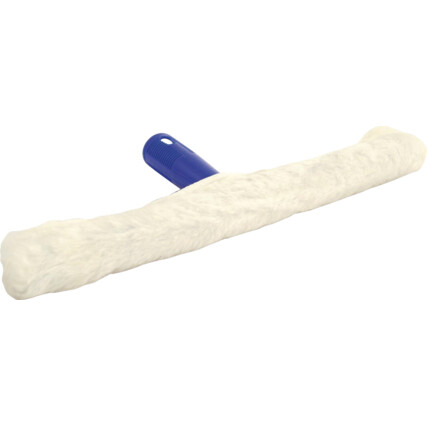
Sleeves slide off the T-bar so you can wash them and put a clean one back on. Keep the sleeve wet through the whole wash. A dry sleeve drags grit across the glass and can scratch it. Rinse it in the bucket between windows so you are not spreading the last window's dirt onto the next one.
Why do window cleaners use a scrim?
A scrim is a lint-free cloth, traditionally linen, used to dry and detail the edges and corners after squeegeeing. It soaks up water without leaving fibres or streaks, which ordinary cloths and paper towel both do. Microfibre cloths do a similar job and are common today.
The squeegee clears the middle of the glass, but a thin line of water always sits along the frame where the blade finished. That is what the scrim is for. Wipe the perimeter, check the corners, and buff out any mark you missed. Keep one cloth for drying and a second, drier one for the final buff.
Kit out with the right window tools
Squeegees, spare rubber blades, applicators, scrims, poles and complete sets, at trade prices with fast Irish delivery.
How do you keep the tools themselves in good order?
Tool care is what separates a clean finish from a streaky one. Change the rubber blade as soon as it stops clearing in one pass, wipe the blade between strokes, keep the applicator sleeve wet and rinsed, wash the cloths between jobs, and refill the bucket once the water turns grey.
Run through the hardware before you blame your technique.
- The blade. Turn the rubber over to use the second edge, then replace it. Spares cost far less than the time lost re-cleaning a pane.
- The blade between strokes. Wipe it on a cloth so it is not carrying water straight back onto the glass.
- The channel. Grit trapped under the rubber lifts it off the glass. Rinse the channel out when you swap a blade.
- The sleeve. Never let it run dry mid-pane, and rinse it between windows so you are not spreading the last window's dirt.
- The cloths. Wash them between jobs and skip fabric conditioner on microfibre, which coats the fibres and stops them absorbing.
- The bucket. Once the water goes grey you are washing with dirt. Refill it.
What goes in the bucket is a separate question, covered in best glass and window cleaner for a streak-free finish. If you are cleaning glass above ground level, a handheld set will only get you so far, and water-fed pole vs traditional window cleaning compares the two approaches.
Frequently asked questions
What tools do you need to clean windows?
You need an applicator to wet and loosen dirt, a squeegee to clear the water in overlapping strokes, a scrim or microfibre cloth to dry the edges, a bucket, and a glass cleaner or pure water. That set cleans any window at ground level. For high glass, add a water-fed pole.
What is a squeegee and how do you use it?
A squeegee is a handled blade with a rubber edge that wipes water and dirt off glass in one clean stroke. Wash the glass first with an applicator, then pull the squeegee down or across in overlapping strokes, wiping the blade between each. Detail the edges afterwards with a scrim.
What size window squeegee should I buy?
Match the width to the glass you clean most. Wide blades clear shop fronts and patio doors in fewer strokes. Narrow blades fit small panes and glazing bars where a wide blade catches on the frame. If you are buying one squeegee only, a medium width handles nearly everything.
What is a scrim used for?
A scrim is a lint-free cloth, traditionally linen, used to dry and detail the edges and corners of glass after squeegeeing. It absorbs water without leaving fibres or streaks, unlike ordinary cloths and paper towel. Microfibre cloths do a similar job and many cleaners now carry both.
Why does my squeegee leave streaks?
The usual cause is a worn rubber blade that no longer sits flat against the glass. Turn the blade over to use the fresh edge, then replace it. Other hardware causes are grit trapped in the channel lifting the rubber off the pane, a wet blade carrying water back onto the glass, and dirty bucket water.
How often should you change a squeegee rubber?
Change it as soon as it stops clearing the glass in one clean pass. The rubber wears with use and picks up nicks from window frames, and both leave lines of water behind. Turning the blade over gives you a second fresh edge before you need a new one, so keep spares in the bucket.