


Foil Containers and Trays: A Sizes Guide (No.2 to No.9)
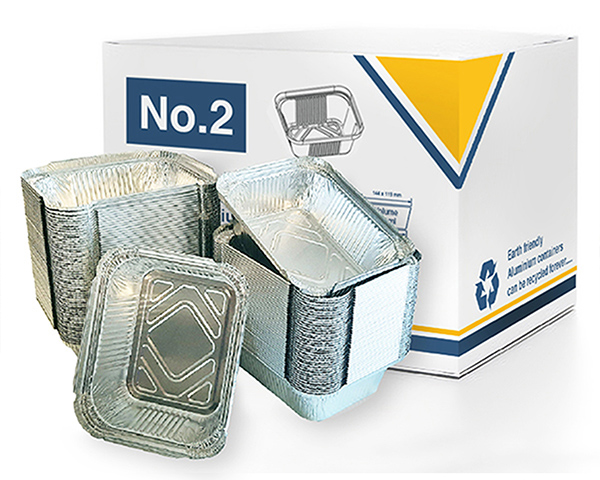
Foil containers come in numbered sizes, from the small No.2 up to large No.9 trays and bigger. The number tells you the shape and capacity, not a measurement in inches. Pick by portion size, a single main in a No.2, a shared or catering portion in a No.9, then match a lid to it.
What do the foil container numbers mean?
The numbers are trade size codes, not dimensions. Each number describes a set shape and capacity that the whole industry recognises, so a No.2 from one supplier holds about the same as a No.2 from another. As a rule the capacity grows as the number grows, with some numbers being deeper or shallower versions of the same footprint.
This is why you cannot work out the size from the name alone. A No.9 is not nine inches. It is simply a bigger tray than a No.2. What matters in practice is the portion it holds and whether it fits your bag, your hot cabinet and your delivery boxes.
Some sizes also come in a deep version. Same footprint, taller walls, more capacity. Deep trays suit curries, stews and anything with a lot of sauce. Shallow trays suit drier food where you want the lid sitting close to the surface.
What size foil container do I need?
Match the container to the portion. Small numbered containers hold a single main such as a curry, a chow mein or a portion of chips. Mid sizes hold a large main or a main with rice. Large trays hold shared, family and catering portions. If food sits proud of the rim, go up a size so the lid seals.
A quick way to decide is to fill your busiest dish into two candidate sizes and look at them. The right container leaves a small gap under the lid. Too much headroom and the food slides around on the journey. Too little and the lid pops or the sauce escapes.
- Single portions, curry, rice, noodles, chips: the smaller numbered containers, with the No.2 the usual default.
- Large single or main with a side: a mid-size or deep container.
- Shared and family portions: the larger trays, including the No.9.
- Catering, buffets and bakes: full-size roasting and gastronorm-style foil trays.
| Size band | Typical capacity | Best for | Depth to pick |
|---|---|---|---|
| Small (around No.2) | One portion | Curry, rice, chips, noodles | Standard or deep for sauce |
| Mid sizes | Large single portion | Main plus a side, kebabs, pasta | Deep for wet dishes |
| Large (around No.9) | Shared or family portion | Family meals, lasagne, bakes | Deep |
| Catering trays | Multiple portions | Buffets, events, meal prep | Deep, with a board or foil lid |
Are foil containers oven and microwave safe?
Foil containers are oven-safe, which is why they suit hot mains, bakes and anything the customer will reheat properly. They must never go in a microwave, because metal is not microwave-safe. Plastic containers are the opposite, fine in a microwave and not in an oven. Tell customers which one they have if it is not obvious.
Foil also holds heat well on the journey, and it takes a stack in a delivery bag without collapsing. The trade-off is that you cannot see through it, so foil is a poor choice for salads, deli items and anything you want the customer to admire before they open it. For those, see deli and salad packaging.
If you are weighing foil against plastic and fibre for a hot menu, the full comparison is in best containers for hot food.
Do foil containers need lids, and which type?
Yes. A foil container without a matching lid is not sealed for transport. Lids are sold per size, so order them together. Board lids are the common choice, cheap and easy to write on. Foil lids let the whole thing go straight in the oven. Clear plastic lids show the food but are not oven-safe.
Whichever you choose, check the lid is sold for the exact container number. A lid from a nearby size will sit on top but will not grip, and it will lift in a delivery bag. Buying container and lid as a pair is the simple way to avoid it.
Order foil containers and lids by the case
Every common numbered size in stock, from No.2 singles to large family trays, with matching lids, at trade prices and fast Irish delivery.
Can you recycle foil takeaway containers?
Clean foil containers are widely recyclable. Aluminium is one of the easier materials to recycle, so scrape the food out, rinse the tray and squash it flat. Greasy, food-soiled foil is the problem, and so are the board lids once they soak up sauce. Those usually go in general waste instead.
That makes foil a reasonable option if recycling matters to your customers, as long as you tell them to rinse it. Material by material disposal is covered in are takeaway containers recyclable.
How many foil containers should you order?
Foil containers are sold by the case, and the unit cost drops sharply at volume. Work out how many of your busiest size you get through in a normal week, then order that size by the case and keep smaller buffers of the rest. Foil stores well and takes up little room when nested, so buying ahead of a busy period is sensible.
Most takeaways settle on two or three sizes rather than the full run. One small single-portion container, one large, and a deep version of whichever you sell most of. That covers nearly every order and keeps your stock simple.
For the wider range that sits around them, start at the takeaway packaging guide, or shop takeaway containers across every material.
Frequently asked questions
What size are foil containers?
Foil containers are sold by trade number rather than by inches. The number sets the shape and capacity, and the capacity grows as the number climbs, from small single-portion containers around the No.2 up to large family and catering trays around the No.9. Many numbers also come in a deep version.
What is a No.2 foil container used for?
The No.2 is the standard single-portion takeaway container. It suits a curry, a portion of rice, noodles, chips or a small main dish. Because it covers the everyday single order, many kitchens keep it as their default size and stock one larger tray alongside it for shared portions.
Are foil containers oven safe?
Yes. Foil containers are oven-safe, which is why they suit hot mains, bakes and food the customer will reheat. They hold heat well in a delivery bag and stack without collapsing. They must never go in a microwave, because metal is not microwave-safe. Plastic containers are the reverse.
Can foil containers go in the microwave?
No. Foil is metal, and metal is not safe in a microwave. If your customers usually reheat in a microwave, use a plastic container instead, or tell them to tip the food onto a plate first. Foil is the better choice where an oven is used for reheating.
Do foil containers come with lids?
Lids are usually sold separately and sized to match each container number, so order the pair together. Board lids are the common option and take a label or pen. Foil lids let the whole container go in the oven. Clear plastic lids show the food but cannot be used in an oven.
Are foil takeaway containers recyclable?
Clean foil containers are widely recyclable, as aluminium is one of the easier materials to recycle. Scrape out the food, rinse the tray and squash it flat before it goes in the bin. Greasy, food-soiled foil and sauce-soaked board lids usually cannot be recycled and go in general waste.