


How Do Pricing Guns Work? Inside a Handheld Price Gun
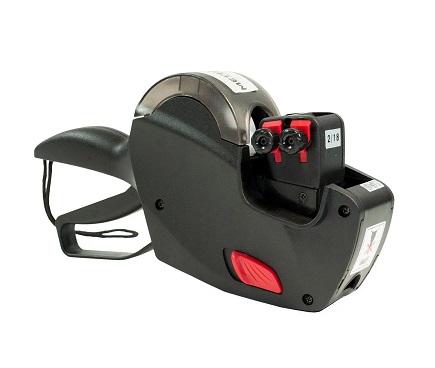
A price gun is a handheld labeller loaded with a roll of self-adhesive labels. You set the price on the number bands, squeeze the trigger, and an inked print head stamps that price onto the next label. The label peels off its backing and feeds onto the roller at the front, ready to press onto the product.
How does a price gun print a label?
A price gun prints by stamping. Inside the body sits a print head made of rotating number bands, and beside it an ink roller. Squeezing the trigger presses the inked characters onto the next label in the roll, then pushes that label forward so it peels off its backing paper and sits on the applicator roller at the front.
There is no power involved. The whole thing runs on the squeeze of your hand, which is why a price gun keeps working in a stock room with no socket and never needs charging. It is a small mechanical press, an ink pad and a paper feed in one plastic body.
The label leaves the gun already sticky, because the backing paper has been pulled away from it inside. You then press the front roller against the product and roll it slightly forward. The label transfers, and the same squeeze that applied it has already set up the next one.
What are the parts of a price gun?
Five parts do the work. The number bands set the price, the ink roller inks them, the trigger drives the print and feed, the label chamber holds the roll, and the applicator roller at the nose presses the finished label onto your stock. Learn those five and any make of gun makes sense.
- Number bands. Small toothed wheels with digits and symbols on them. You turn them to build the price.
- Ink roller. A soft inked cylinder that sits against the bands. It is a consumable and gets replaced, not refilled, on most guns.
- Trigger and print head. One squeeze presses the bands onto the label and advances the roll.
- Label chamber. Holds the roll and its spindle. This is the part you open to reload.
- Applicator roller. The brush or roller at the front that sticks the label down.
Two-line guns have two sets of number bands and print two rows. Which one suits your shop is covered in 1-line vs 2-line price guns.
What happens when you squeeze the trigger?
One squeeze runs three actions in sequence. The print head drops onto the label and stamps the inked characters. The feed mechanism then draws the strip forward by exactly one label. As the strip turns the sharp peel edge inside the gun, the printed label separates from its backing and lands face up on the applicator roller.
That peel step is the part most people never see and the reason a price gun feels quicker than any other way of pricing by hand. The label is already free of its backing before it reaches the nose, so applying it is one motion rather than two. The backing paper carries on through the gun as a spent ribbon and drops out the back.
It also explains why the gun is fussy about the roll. The feed pulls by a fixed distance, so a label pitch that does not match the gun leaves the print sitting half off the edge or two labels arriving at once. That is a supply problem, not a fault in the mechanism.
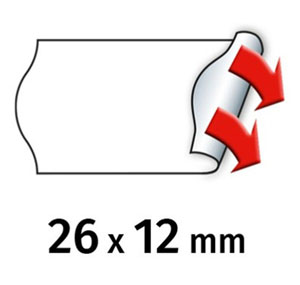
Reloading is a short routine once you know the order of the steps, and it is written out end to end in how to change and load price gun labels. Which roll to order in the first place is in price gun labels: sizes, colours and which fit your gun.
Price your stock faster
One-line and two-line price guns, matching labels and ink rollers, at trade prices with fast Irish delivery.
How do you set the price on a price gun?
You set the price by hand on the number bands, usually reached through a small window or panel on the side of the gun. Turn each band with a fingertip or the tip of a pen until the digits you want line up. There is nothing to type and no screen to read.
Work from the right, so from cents up to euro, and check the whole line before you print. Print one test label onto scrap and read it. That habit stops the classic mistake of pricing a full shelf at 1.50 when you meant 15.00.
Unused positions on the band are usually left blank rather than set to zero, so a two-digit price does not print with a stray leading digit. On a two-line gun the second row is set the same way, and shops mostly use it for a date, a stock code or a was-and-now offer price.
What can a price gun not do?
A price gun prints only what its bands carry, so you get digits, a currency symbol and a handful of common marks. It cannot print a barcode, a product name, a description or anything held in your till system. It also will not hold on fabric, because it applies a sticky label rather than a fastener.
Those two limits decide when a shop needs a second tool. Scannable labels and printed product data come from a barcode label printer. Clothing and soft goods take a swing ticket fired on with a plastic fastener rather than a sticker. Both sit alongside the price gun rather than replacing it.
Within its own job the gun is hard to beat. No power, no computer, no setup, and a priced label on the shelf in one movement. For the wider picture on guns, labels, tagging and barcode printers, read the price guns and labelling guide.
Frequently asked questions
How do pricing guns work?
A price gun is a handheld labeller loaded with self-adhesive labels. You set the price on rotating number bands inside the gun. Squeezing the trigger presses those inked characters onto the next label and feeds it forward, peeling it off its backing so it sits on the roller at the front, ready to press onto the product.
What are the parts of a price gun?
Five parts do the work. The number bands are the toothed wheels you turn to set the price. The ink roller inks them. The trigger drives the print and feeds the roll. The label chamber holds the roll and its spindle. The applicator roller at the nose presses the finished label onto your stock.
Do price guns need batteries or power?
No. A price gun is fully mechanical and runs on the squeeze of the trigger, so there is nothing to charge and no socket needed. The only consumables are the label rolls and the ink roller that inks the number bands. That is why price guns still suit stock rooms and shelf work.
How do you change the price on a price gun?
The price is set by hand on the number bands, reached through a small window or panel on the side of the gun. Turn each band until the digits line up, working from cents up to euro. Print one test label onto scrap and read it back before you start pricing stock.
Why is my price gun printing faint labels?
Faint or patchy print nearly always means the ink roller has dried out or worn down. Ink rollers are consumables and get replaced rather than refilled on most guns, so fit a fresh one that matches your gun model. If print is missing entirely, check the ink roller is seated against the number bands.
Can a price gun print anything other than numbers?
No. A price gun prints only what sits on its number bands, so you get digits, a currency symbol and a few common marks. It cannot print a barcode, a product name or anything pulled from your till system. For those you need a barcode label printer rather than a handheld pricing gun.