


Wide-Format Till Rolls: When You Need a 76mm+ Roll

Wide-format till rolls are receipt and printer rolls wider than the everyday 57mm receipt size, most often 76mm and above. They feed kitchen printers, ticketing machines, weighing scales and labelling printers that will not take a small roll. Match the exact width your machine expects before you order.
What counts as a wide-format till roll?
Wide-format covers any roll wider than the small receipt sizes most tills use. Two widths run the checkout, 57mm for card machines and 80mm for tills. Anything outside that pair sits in the wide-format group, and in practice that means 76mm impact rolls and the broader rolls used by ticketing, weighing and labelling printers.
The name is about the paper, not the printer brand. A wide roll gives you more room across the page, so you can print longer product names, bigger order lines, a barcode or a label that a narrow receipt cannot hold. That is the whole point of it. If your printout keeps wrapping onto a second line or getting cut off at the edges, the width is usually the reason.
Wide-format is one of several jobs a standard white roll cannot do. The others are set out in the parent guide, specialist till and receipt rolls.
Why do 76mm rolls exist when tills use 80mm?
76mm is the width impact printers were built around. An impact printer strikes the paper through a ribbon rather than heating it, so it is a different machine with its own paper size. Kitchens still favour them because the print survives steam and heat, and because 76mm rolls come as carbonless 2-ply and 3-ply for instant copies.
So 76mm and 80mm are not two names for the same thing. An 80mm thermal roll will not run properly in a 76mm impact printer, and a 76mm roll sits loose in an 80mm holder. The 4mm sounds small on paper. Inside the machine it is the difference between a clean feed and a jam.
Kitchen printers are also the main reason people meet multi-ply rolls for the first time. One copy goes to the kitchen, one stays at the pass. How that works without carbon paper is covered in what is carbonless paper.
Which machines need a wide-format roll?
Kitchen and dockets printers are the biggest group, usually on 76mm. Beyond that, ticketing machines, weighing scales in butchers and delis, some labelling printers and older office equipment all take wider stock. If a machine prints anything more detailed than a short receipt, it is worth checking the width it expects.
- Kitchen and docket printers in restaurants, takeaways and pubs, commonly 76mm impact, often 2-ply.
- Weighing scales with a built-in printer, where the label carries weight, price and a barcode.
- Ticketing and queue printers that need room for times, seat numbers or references.
- Labelling printers where the label itself is wider than a receipt.
- Older impact tills and office printers that predate the 80mm thermal standard.
| Roll width | Typical machine | Usual paper |
|---|---|---|
| 57mm | Card machines, taxi meters, tachographs | Thermal |
| 76mm | Kitchen and docket printers, older impact tills | Plain or carbonless 2-ply and 3-ply |
| 80mm | Shop tills and receipt printers | Thermal |
| Wider than 80mm | Ticketing, weighing and labelling printers | Thermal or plain, machine dependent |
How do you check the width you need?
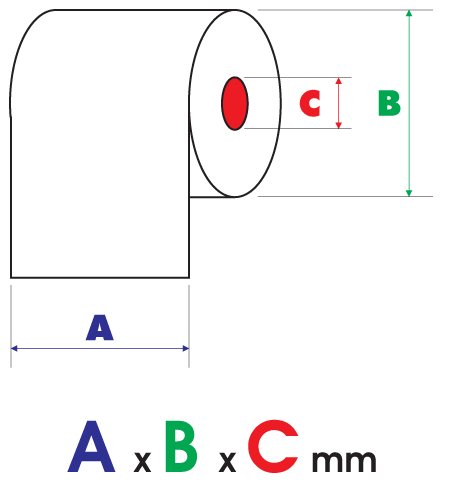
Measure the roll you already have. Lay a ruler across the flat end of the roll and read the width in millimetres. Then measure the diameter across the circle, and the hole in the middle, which is the core. Those three numbers are what you order by, in that order.
If you have no old roll to hand, the width is normally printed inside the paper compartment of the printer, on the machine's label, or in the manual. A photo of the empty box works too. Send it to us and we will match it.
Watch out for one trap. A roll can be the right width and still not fit, because the diameter is too big to close the lid or the core is the wrong size for the spindle. Check all three. The three numbers are explained in till roll sizes explained, and machine-by-machine fit is in the till roll compatibility guide.

Can you use a narrower roll instead?
No, not reliably. A narrow roll in a wide holder wanders as it feeds, so the print drifts, the paper skews and the sensor can miss it. A roll that is too wide will not fit at all, or it rubs on the housing and tears. Order the width the machine was built for.
People try it when a delivery is late, and it nearly always costs more time than it saves. Jammed paper stops service at the worst moment. Keeping one spare box of the correct size on the shelf is the cheaper answer, especially in a kitchen where the printer runs all evening.
Order wide-format rolls by the box
76mm kitchen and impact rolls, plain and carbonless, plus wider sizes for ticketing and weighing printers. Trade prices and fast Irish delivery from our Cavan warehouse.
What else should you order with them?
Impact printers need a ribbon as well as paper, so check the ribbon while you are ordering the rolls. If the printer runs 2-ply, decide whether a third copy would help before you settle on a size, because switching later means changing the whole box. Restaurants that write orders by hand as well as print them often pair the rolls with waiter order pads, and kitchens that run several stations sometimes add coloured thermal rolls elsewhere in the shop to tell dockets apart at a glance.
Frequently asked questions
What is a wide-format till roll?
A wide-format till roll is any receipt or printer roll wider than the small everyday receipt sizes. Most tills use 57mm or 80mm, so anything outside that pair counts as wide-format. In practice it means 76mm impact and kitchen rolls, plus the broader rolls used by ticketing, weighing and labelling printers.
What is a 76mm till roll used for?
76mm is the impact printer width. It is used by kitchen and docket printers, older impact tills and some office machines that strike the paper through a ribbon instead of printing with heat. 76mm rolls are often supplied as carbonless 2-ply or 3-ply so the printer makes instant copies.
Is a 76mm roll the same as an 80mm roll?
No. They are two different widths for two different machines. 80mm is the standard thermal till and receipt printer size, while 76mm suits impact and kitchen printers. An 80mm roll will not feed properly in a 76mm printer, and a 76mm roll sits loose in an 80mm holder.
Which machines need wide-format rolls?
Kitchen and docket printers are the most common, usually on 76mm. Weighing scales with a built-in printer, ticketing and queue printers, some labelling printers and older impact tills also take wider stock. If the printout carries more than a short receipt line, check the width the machine expects.
How do I measure my till roll?
Lay a ruler across the flat end of the roll to read the width in millimetres. Then measure the diameter across the circle, and the hole in the middle, which is the core. Order by those three numbers. The width is also often printed inside the printer's paper compartment.
Can I use a narrower roll if the right size is out of stock?
It is not worth doing. A narrow roll wanders inside a wider holder, so the print drifts, the paper skews and the paper sensor can miss it. A roll that is too wide will not fit or will tear on the housing. Keep a spare box of the correct size instead.