


Laundry Tag Rolls: Sizes and Uses for Dry Cleaners

What are laundry tag rolls?
Laundry tag rolls are rolls of small, tough tags used by dry cleaners and launderers to label garments. Each tag prints with the customer, the order number and often the item and any special instructions. Staff attach one tag to every piece as it is booked in, and it stays on until collection.
The tag is not a receipt. A receipt goes to the customer. A tag stays with the clothes. That is why the format is different: tags are narrow, short and made to survive handling, heat and steam without falling apart or going blank.
They are one of the specialist formats covered in our specialist till and receipt rolls guide, alongside tachograph rolls, taxi rolls and coloured thermal.
How do dry cleaners use tag rolls?
The tag is applied at the counter, the moment an order is booked in. Staff print a tag for every garment, attach it, and the garment then moves through sorting, cleaning, pressing and racking with its own label. At collection, the tag is matched back to the customer ticket before anything is handed over.
The reason it matters is simple. A busy shop takes in a lot of near-identical black jackets and white shirts in a week. Without a tag on each one, sorting is guesswork and mixed orders are only a matter of time. A wrong garment handed to a customer costs you the replacement, the goodwill and often the customer.
Typical uses on the shop floor:
- Matching every item back to one customer and one order.
- Keeping split orders together when garments are cleaned in different batches.
- Flagging special handling, such as stains, delicate fabrics or repairs.
- Tracking work between a shop counter and an off-site cleaning plant.
- Speeding up the search on the collection rail.
What size laundry tag rolls do you need?
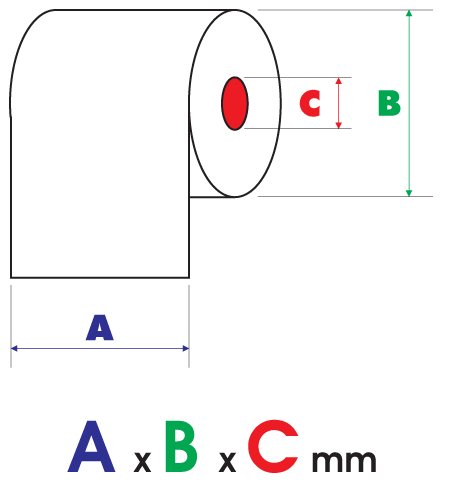
Your tagging printer decides the size, so start there. You need the tag width, the tag length and the core size the machine takes. Check the box the last roll came in, or measure the old roll before you order. Order the wrong width and the roll will not feed at all.
This works the same way as any roll on a machine. Width is the first number to get right, because a roll that is too wide will not fit the holder and one that is too narrow will wander and misprint. Length and core then decide how often staff have to reload. If you are unsure how to read the numbers on a roll, our till roll sizes guide explains the three measurements.
If you cannot find the size anywhere, send us the make and model of the tagging printer, or a photo of the old box or the roll end. We will match it.
How is a laundry tag roll different from a till roll?
A till roll prints a continuous receipt for the customer to take away. A tag roll prints short, separate tags that stay attached to goods. Tag stock is stiffer and more hard-wearing, sized to a tagging printer rather than a till, and the print has to last the whole cleaning cycle.
| Feature | Standard till roll | Laundry tag roll |
|---|---|---|
| What it prints | A continuous receipt | Short individual tags |
| Who keeps it | The customer | Stays on the garment |
| Paper stock | Light receipt paper | Tougher tag stock |
| Machine | Till or receipt printer | Garment tagging printer |
| Life expected | Minutes to months | The full cleaning cycle |
Plenty of dry cleaners buy both. The counter till still needs standard rolls for customer receipts, and the tagging printer needs tag rolls. It is worth putting both on the same order so you only pay delivery once.
Order laundry tag rolls for your shop
Tag rolls matched to your tagging printer, at trade prices, with fast Irish delivery from our Cavan warehouse. Not sure of the size? Send us the machine model.
Do laundry tags need a ribbon, or are they thermal?
It depends on the machine. Some tagging printers are direct thermal and print with heat alone, so the roll is the only thing you buy. Others are thermal transfer and need a ribbon as well. Check which type your printer is before you order, because the two are not interchangeable.
Direct thermal is cheaper to run and simpler to reload, since there is no ribbon to change. A ribbon print tends to hold up better against heat, steam and rubbing, which is why some plants prefer it for garments going through a full press cycle. If you are not sure which yours is, look for a ribbon spool inside the machine when you open it to reload. No spool means direct thermal. How thermal printing works is explained in thermal till rolls explained.
How many tag rolls should you keep in stock?
Keep enough to cover your busiest week plus a spare box. Tag use rises with garment count, not order count, so a single family order can eat a lot of tags. Running out mid-shift means either hand-writing labels or turning work away, and neither is worth the saving on a smaller order.
Work it out from your own numbers. Count the garments you book in during a normal week, add your peak weeks, and order in boxes rather than singles. Buying by the box costs less per roll and cuts the number of deliveries you wait on. Store the spare boxes away from heat, sunlight and damp, because heat marks thermal stock before it ever reaches the printer.
If you supply other trades from the same counter, it is worth looking at what else runs on specialist stock. Cabs use taxi receipt rolls, kitchens use carbonless 2-ply and 3-ply rolls, and colour-coding jobs use coloured thermal rolls.
Frequently asked questions
What are laundry tag rolls?
Laundry tag rolls are rolls of small, hard-wearing tags used by dry cleaners and launderers. Each tag prints with the customer name, order number and any handling notes, then attaches to a garment at drop-off. The tag stays on the item through cleaning and pressing so it can be matched back to the right order at collection.
Do dry cleaners use special tag rolls?
Yes. Dry cleaners use laundry tag rolls rather than standard receipt rolls. The tags are narrow, tougher and sized to fit a garment tagging printer, because they have to stay attached and readable through the whole cleaning cycle. A normal till roll is too light and is made for a customer receipt instead.
What size laundry tag rolls do I need?
The tagging printer sets the size, so check the machine first. You need the tag width, the tag length and the core size. The easiest way is to read the box the last roll came in, or measure the old roll before ordering. Send us the printer model and we will match the correct roll for you.
Are laundry tag rolls thermal?
Some are and some are not. Direct thermal tagging printers print with heat alone, so the roll is the only consumable. Thermal transfer printers need a ribbon as well as the roll. Open the machine and look for a ribbon spool. If there is no spool, your printer is direct thermal and takes a plain tag roll.
How is a laundry tag different from a till receipt?
A till receipt is a continuous strip printed for the customer to take away. A laundry tag is a short separate label that stays attached to a garment. Tag stock is stiffer and more durable, and it prints on a tagging printer rather than a till, because it has to survive handling, heat and steam.
Can I buy laundry tag rolls in Ireland?
Yes. Shop4Rolls supplies laundry and dry cleaning tag rolls to Irish businesses at trade prices, with fast delivery from our Cavan warehouse. Order by the box to cut the cost per roll. If you cannot find the size, send us your tagging printer model or a photo of the old box and we will match it.